🏛️ History of Astrological Analysis: A 4000-Year Symbolic Journey
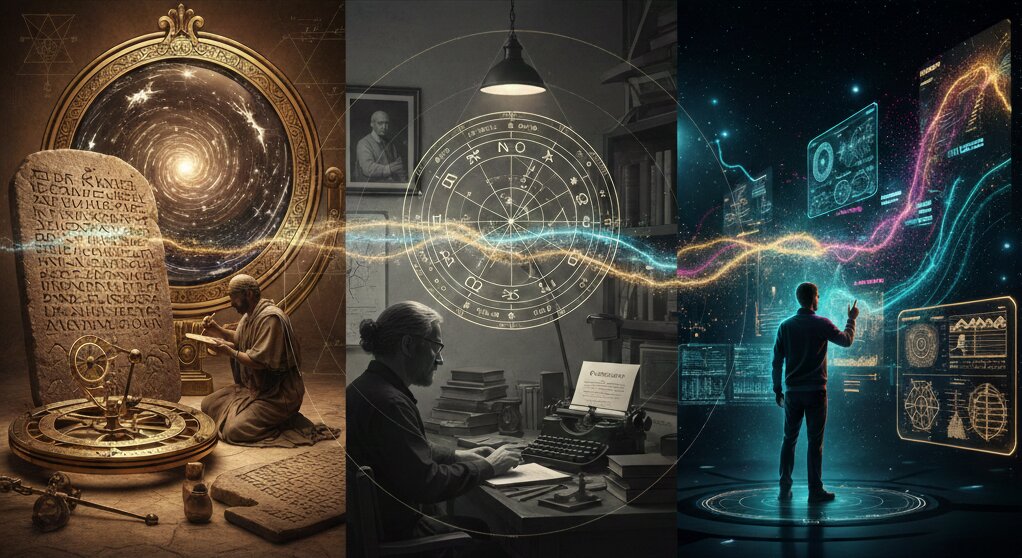
The 4000-year evolution of mapping destiny. Click to read on Gemicha.com
While psychology attempts to model the mind and sociology the society, astrology has tried for millennia to model time and destiny. The fundamental question behind astrological analysis was: "Is there a symbolic link between human character and the cosmic order?" At Gemicha Lab, we analyze this ancient system not as prophecy, but as a deep layer of archetypal data that structures the human narrative.
🏺 1. Mesopotamia: The First Celestial Records (2000 BC)
The roots of astrological analysis stretch back to ancient Babylon. They were the first civilization to systematically record planetary movements and calculate eclipses. At that time, astrology was a state-focused early warning system; changes in the sky were linked to the kingdom's future, risks of famine, or the course of wars. For the first time, the celestial order was transformed into an archivable and comparable data set.
🏛️ 2. Ancient Greece: Systematic Character Model (300 BC)
The Greeks merged raw celestial data from Babylon with geometry and philosophy. The most critical figure was Claudius Ptolemy and his immortal work, "Tetrabiblos". Ptolemy transformed astrology into a systematic character typology, individualizing the system of 12 signs and the 4-element model (fire, earth, air, water) for the first time.
🔭 3. Rome & The Middle Ages: Bridge of Knowledge
While the West stagnated during the early Middle Ages, the torch of analysis passed to the Islamic world. In the observatories of Baghdad, Cairo, and Andalusia, trigonometry and measurement techniques reached their peak. Muslim scholars perfected chart-casting techniques, laying the foundation for today's modern computational methods that power our algorithms.
📜 4. Renaissance: The Great Separation from Science
Until the 17th century, astronomy and astrology were considered the same discipline. Figures like Johannes Kepler discovered physical planetary laws while performing symbolic analyses for the nobility. However, after the Newtonian revolution, astrology separated from physics to sow the seeds of future "depth psychology," focusing on the inner world rather than physical movement.
🧠 5. 19th Century & Carl Jung: Psychological Astrology
With the increasing importance of individuality after the Industrial Revolution, astrology transformed into a psychic symbolic structure. Carl Gustav Jung saw astrology as an "archetypal mirror" of the human psyche. His theory of "Synchronicity" argued that astrology should not be read through cause and effect, but through a meaningful language of symbols.
📰 6. 20th Century: Massification and Horoscopes
In the 20th century, astrology became part of mass culture via the press. Although sun-sign-based horoscopes simplified the system, this period was crucial for keeping human curiosity about the cosmic connection alive before the digital age. Astrological analysis became a social tool for identity.
💻 7. 2000–2026: The Algorithmic and Digital Era
Today, natal charts that were calculated by hand for millennia are generated in seconds by AI algorithms. Systems like Gemicha merge ancient symbolic language with modern neural network analysis, transforming static analysis into a dynamic, predictive, and ultra-personalized content stream.
Conclusion: The Power of Symbols
At Gemicha Lab, astrological data is just one layer of your identity. Symbols have structure and direction. For us, astrology does not represent the physical sky, but the infinite symbolic richness in the human desire to understand oneself and one's place in the universe.
📚 Bibliography (APA)
- Ptolemy, C. (2nd Century AD). Tetrabiblos.
- Jung, C. G. (1952). Synchronicity: An Acausal Connecting Principle.
- Castells, M. (1996). The Rise of the Network Society.
🌍 Prefer to read in another language?
We have translated this 4000-year history into multiple languages. Click below to read the localized version on the official Gemicha platform:
Your Smart AI Chat Companion & Daily Astrologer
Gemicha is a unique AI chat app where you can engage in deep, unfiltered conversations and also check your daily horoscope. Create your custom AI persona, explore daily zodiac insights, and start chatting today!



Comments
Post a Comment